


Photography Dissertation Topics for 2026

Students across universities frequently post questions on academic forums, Reddit threads, and higher education communities when they reach the dissertation stage. Below is a collection of the most common questions gathered from those platforms — questions that this guide will answer clearly and practically.
- What are the best photography dissertation topics I can actually research in 2026?
- How do I know if a photography topic is suitable for my undergraduate or master’s level?
- Are there any fresh photography research topics that examiners have not seen a hundred times before?
- Can I combine digital photography with social issues for my dissertation?
- What makes a photography thesis topic strong and researchable?
- Where can I find photography dissertation topics with examples to guide my proposal?
- Is photojournalism still a viable research area, or are there more contemporary directions?
- How do I narrow a broad visual arts topic into a focused dissertation question?
Choosing the right dissertation topic in photography is one of the most important academic decisions a student makes. Photography is no longer a purely technical subject. It now sits at the intersection of culture, politics, technology, ethics, and identity. That breadth makes it exciting — but it also makes topic selection genuinely difficult.
A well-chosen topic gives your research direction, keeps your argument focused, and helps you demonstrate genuine scholarly engagement with the field. If you are searching for photography dissertation topics that are original, academically robust, and relevant to 2026, this post has been written for you.
Whether you need photography dissertation help to get started or you are already mid-way through your proposal, the structured guidance below will support every stage of your research decision.
Download Photography Dissertation Topics PDF
Students who prefer a curated, ready-to-use list can receive a downloadable PDF of photography dissertation topics personalised to their academic level and research interests. Academic experts compile this PDF to ensure every topic meets current dissertation standards.
After completing a short form with a few details about your course level and research preferences, the PDF is prepared and sent directly to you. This resource is particularly useful if you are still at the exploratory stage and want to see a wider range of well-structured ideas before settling on one direction.
Why Choosing the Right Photography Dissertation Topic Matters
Photography research is growing in academic scope and ambition. Universities now expect dissertations that go beyond technical analysis and instead engage critically with representation, memory, power, technology, and society. A weak or overly broad topic undermines the quality of your entire research project, regardless of how well you write.
A strong photography thesis topic demonstrates that you understand the field, have identified a genuine gap in existing research, and can develop a focused argument over the full length of a dissertation. Examiners assess your topic selection as part of evaluating your academic judgment.
For students pursuing visual arts dissertation topics, the challenge is often to move from a general interest — such as documentary photography or portrait photography — into a specific, researchable question. This guide will help you make that move with confidence.
Key Research Areas in Photography You Can Explore
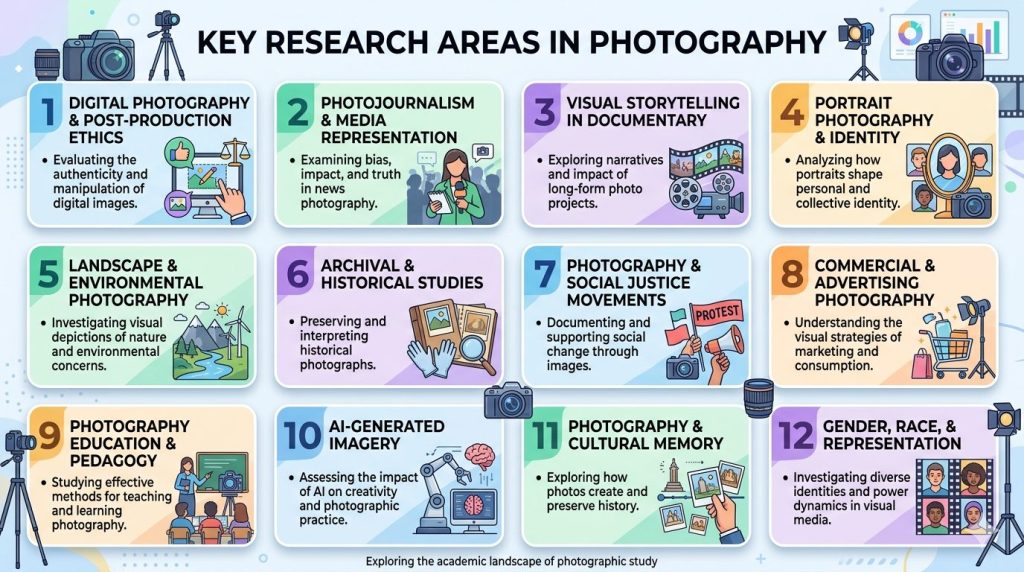
Photography covers a wide range of established academic domains. Understanding these areas helps you identify where your own interests and skills can generate an original contribution. Below are the core research areas that scholars and practitioners actively engage with.
- Digital photography and post-production ethics
- Photojournalism and media representation
- Visual storytelling in documentary and long-form projects
- Portrait photography and identity construction
- Landscape and environmental photography
- Archival and historical photography studies
- Photography and social justice movements
- Commercial and advertising photography
- Photography education and pedagogy
- AI-generated imagery and its impact on photographic practice
- Photography and cultural memory
- Gender, race, and representation in visual media
- Mobile photography and social media platforms
- Lighting techniques and their psychological effects on viewers
Photography Dissertation Topics with Examples: Five Structured Models
The following five examples show how a dissertation topic translates into a clear research aim and focused objectives. These models are designed to help you understand the academic structure before you develop your own.
Example 1: Digital Photography and Authenticity
Topic: How does AI-assisted editing challenge the perceived authenticity of digital photography in photojournalism?
Research Aim: To critically examine how the integration of AI editing tools is reshaping authenticity standards in photojournalistic practice.
Objectives:
- To analyse how major news organisations define and enforce authenticity in digital photography.
- To evaluate the role of AI post-processing tools in altering photojournalistic images.
- To assess public and professional responses to AI-manipulated news photographs.
Example 2: Portrait Photography and Identity
Topic: In what ways does contemporary portrait photography challenge or reinforce gender identity norms in British fashion media?
Research Aim: To investigate the visual construction of gender identity in UK fashion portrait photography between 2020 and 2026.
Objectives:
- To identify recurring visual conventions in gender representation within British fashion photography.
- To examine how photographers actively subvert or reinforce mainstream gender norms through compositional choices.
- To compare editorial approaches across print and digital fashion platforms.
Example 3: Documentary Photography and Social Change
Topic: How has documentary photography been used as a tool for social advocacy in climate change campaigns since 2015?
Research Aim: To explore the function of documentary photography in advancing environmental activism and shaping public perception of climate change.
Objectives:
- To survey major documentary photography projects associated with climate activism since the Paris Agreement.
- To analyse how visual storytelling techniques are used to create emotional engagement with environmental subjects.
- To evaluate the measurable impact of photographic campaigns on public climate awareness.
Example 4: Lighting Techniques and Emotional Response
Topic: How do specific lighting techniques in commercial portrait photography influence consumer emotional response to brand campaigns?
Research Aim: To determine whether deliberate lighting choices in commercial portrait photography produce measurable differences in consumer emotional engagement.
Objectives:
- To catalogue the most commonly used lighting techniques in UK commercial portrait photography campaigns.
- To conduct a viewer response study measuring emotional reactions to images with different lighting setups.
- To compare brand recall rates across campaigns using contrasting lighting approaches.
Example 5: Mobile Photography and Social Media Culture
Topic: To what extent has the democratisation of mobile photography through platforms like Instagram changed professional standards in visual arts?
Research Aim: To critically assess the influence of mobile photography culture on professional photographic standards and industry expectations.
Objectives:
- To trace how mobile photography platforms have influenced visual aesthetics in professional commercial work.
- To gather professional photographers’ perspectives on industry standard shifts caused by mobile image culture.
- To evaluate whether mobile photography platforms have widened or narrowed access to visual arts careers.
80 Photography Dissertation Topics for 2026
The following 80 photography research topics are organised by subfield and suitable for undergraduate, master’s, and PhD research. Each topic is specific, researchable, and aligned with contemporary academic expectations. Use these as starting points for developing your own proposal, adapting language and scope to match your course requirements.
Photojournalism and Media Representation
- 1. The impact of smartphone journalism on traditional photojournalism ethics in UK newsrooms.
- 2. How photojournalists navigate editorial pressure when documenting conflict zones in post-2020 reporting.
- 3. The representation of asylum seekers in British photojournalism: a critical visual analysis.
- 4. How AI-generated images are being used in news media and what this means for photojournalism credibility.
- 5. A comparative study of racial representation in photojournalism across major UK and US publications.
- 6. Female photojournalists in conflict zones: professional barriers and visual perspectives.
- 7. The shift from print to digital photojournalism and its effect on image editing standards.
- 8. How climate change photojournalism has evolved between 2010 and 2026 in international news coverage.
- 9. Audience trust and image manipulation: how readers respond when photojournalistic authenticity is questioned.
- 10. Visual framing of protest movements in photojournalism: a study of Black Lives Matter coverage.
Digital Photography, Technology, and Ethics
- 11. Ethical implications of AI upscaling and restoration in digital photography archives.
- 12. How deepfake technology is undermining photographic evidence in legal and journalistic contexts.
- 13. NFTs and digital photography: ownership, authenticity, and the commercialisation of visual art.
- 14. The role of metadata in protecting copyright in digital photography in the streaming age.
- 15. Computational photography in smartphones: does auto-HDR processing reduce artistic intentionality?
- 16. Post-production ethics in commercial digital photography: where does retouching become misrepresentation?
- 17. Cloud storage and digital archiving: how photographers manage long-term preservation of digital work.
- 18. Surveillance photography and civil liberties: a critical study of CCTV imagery in UK public spaces.
- 19. The algorithmic curation of photography on social media and its effect on visual diversity.
- 20. How drone photography is changing landscape documentation and raising new ethical questions.
Documentary Photography and Visual Storytelling
- 21. Visual storytelling techniques in long-form documentary photography projects about urban poverty.
- 22. How contemporary documentary photographers balance objectivity and advocacy in social issue projects.
- 23. A study of visual narrative structure in photo essay collections published post-2015.
- 24. The ethics of photographing vulnerable populations: informed consent and dignity in documentary work.
- 25. How documentary photography has responded to the mental health crisis in post-pandemic Britain.
- 26. Revisiting the archive: how photographers are using historical documentary images to challenge contemporary narratives.
- 27. The influence of Instagram’s storytelling format on the structure of documentary photography projects.
- 28. Collaborative documentary photography: how co-created projects with communities challenge traditional authorship.
- 29. Visual witness and memory: the role of documentary photography in post-conflict reconciliation.
- 30. How gender shapes the documentary gaze: comparing male and female photographers’ approaches to social subjects.
Portrait Photography and Identity
- 31. How portrait photography has been used historically and contemporarily to construct national identity.
- 32. Self-representation and selfie culture: a critical study of identity performance through mobile portrait photography.
- 33. The psychological relationship between portrait subjects and photographers: power dynamics in the studio.
- 34. How LGBTQ+ identity is constructed and contested in contemporary British portrait photography.
- 35. Disability and portrait photography: from passive subject to active self-representational practice.
- 36. Ageing and dignity in portrait photography: how older subjects are represented in UK commercial and editorial work.
- 37. The influence of fine art portrait photography on commercial advertising aesthetics.
- 38. Child portraiture and safeguarding ethics: navigating the boundaries of photographic consent.
- 39. Cultural identity in diaspora portrait photography: a study of British South Asian visual self-representation.
- 40. How lighting techniques in portrait photography signal social class and professional status to viewers.
Environmental and Landscape Photography
- 41. The aestheticisation of environmental destruction in landscape photography: beauty versus accountability.
- 42. How British landscape photography has responded to rewilding and conservation movements.
- 43. Night photography and light pollution advocacy: how astrophotography is being used in environmental campaigns.
- 44. Underwater photography and ocean conservation: documenting the impact of plastic pollution.
- 45. The post-industrial landscape in British photography: memory, decline, and regeneration.
- 46. How aerial photography from drones is transforming environmental monitoring and advocacy.
- 47. Sacred landscapes and photography ethics: representing indigenous land in Western photographic traditions.
- 48. Urban nature photography: how photographers are documenting biodiversity in British city environments.
- 49. Ice and climate imagery: a visual analysis of how glacier photography is used in environmental communication.
- 50. Photography and rewilding narratives: how visual storytelling is shaping public attitudes to habitat restoration.
Commercial, Advertising, and Fashion Photography
- 51. Body image and advertising photography: how retouching regulations are reshaping the UK industry.
- 52. Sustainability in fashion photography: how brands use visual storytelling to communicate ethical credentials.
- 53. The role of commercial portrait photography in shaping professional personal branding on LinkedIn.
- 54. How food photography aesthetics on social media have influenced restaurant menu design and consumer expectations.
- 55. The use of colour psychology in commercial photography campaigns targeting Generation Z consumers.
- 56. Behind the scenes: how commercial photographers navigate client briefs versus creative autonomy.
- 57. The decline of print advertising and its effect on commissioned photography in the UK media industry.
- 58. How representation of diversity in advertising photography has changed following the 2020 social justice movement.
- 59. Virtual try-on technology and AI product photography: implications for professional commercial photographers.
- 60. The visual language of luxury brand photography: consistency, aspiration, and exclusivity in image-making.
Archival, Historical, and Memory Photography
- 71. How family photograph albums construct and transmit cultural memory across generations.
- 72. The ethics of digitising colonial photographic archives: who owns historical visual records?
- 73. Photography and grief: how bereaved families use images in memorial practice in contemporary Britain.
- 74. The political use of historical photographs in national identity campaigns: a case study approach.
- 75. How First World War photography has been recontextualised in contemporary visual arts exhibitions.
- 76. Personal photography archives in the age of cloud storage: preservation, access, and digital loss.
- 77. The community photography movement in 1970s Britain and its legacy in contemporary participatory practice.
- 78. How museum curators select and interpret historical photographs for public display.
- 79. The role of photography in testimony and transitional justice: visual evidence in post-conflict societies.
- 80. AI colourisation of black-and-white historical photographs: authenticity, ethics, and public reception.
[INFOGRAPHIC PLACEMENT — Insert a numbered grid or table infographic here showing all 80 photography dissertation topics organised by category. Title: ’80 Photography Dissertation Topics for 2026 at a Glance’. Alt Text: Infographic listing 80 photography dissertation topics for 2026 organised into eight research categories]
How to Choose the Right Photography Dissertation Topic for Your Level
Photography Dissertation Topics for Undergraduate Students
At undergraduate level, your examiner expects you to demonstrate a clear understanding of the field, a focused research question, and the ability to review existing literature critically. You do not need to produce entirely new knowledge, but you do need to show informed analysis.
Strong undergraduate photography dissertation topics for 2026 tend to focus on a single, well-defined issue within a specific cultural, historical, or technical context. Avoid topics that require primary fieldwork you cannot practically carry out within your timeframe. Topics in areas such as portrait photography, social media and visual culture, or the ethics of commercial image-making work particularly well at this level.
Masters Photography Dissertation Topics
Master’s dissertations in photography require a higher level of theoretical engagement and methodological rigour. You should identify a genuine gap in the literature and design your research around addressing it systematically.
Masters photography dissertation topics often combine two disciplines or subfields — for example, documentary photography and postcolonial theory, or digital photography and AI ethics. This interdisciplinary approach signals intellectual maturity and positions your research within broader academic conversations. If you are looking for online dissertation help to develop a strong master’s proposal, working with an academic adviser early is always beneficial.
Photography Dissertation Topics for PhD Research
At PhD level, the expectation is that your research makes an original and significant contribution to knowledge. Photography PhD projects typically involve substantial primary research — this could include interviews with practitioners, large-scale image analysis, ethnographic fieldwork in photographic communities, or the creation of original practice-based work alongside a written thesis.
The latest photography research topics that are attracting doctoral funding in 2026 include AI and photographic authenticity, the decolonisation of visual archives, photography’s role in transitional justice, and the environmental ethics of contemporary image-making. Your proposal should demonstrate a clear theoretical framework and explain why your question has not been adequately addressed by existing scholarship.
Practical Tips for Developing Your Photography Project Ideas
Turning a broad interest into a focused dissertation question takes time and deliberate thinking. Below are practical strategies that experienced academic researchers recommend.
Start with a Problem, Not a Subject
The most common mistake students make is beginning with a subject — such as photojournalism or portrait photography — rather than a problem. A subject is too large for a dissertation. A problem is specific, debatable, and researchable.
Ask yourself what is contested, unresolved, or underexplored within the area you are interested in. That question is the seed of your dissertation.
Review Recent Academic Literature Before Confirming a Topic
Before committing to any of the photography research topics listed above, conduct a brief literature review. Use databases such as JSTOR, Google Scholar, and your institution’s library portal to find recent journal articles. If you find dozens of papers on your exact topic, the area may be saturated. If you find almost nothing, reconsider whether there is a genuine research base to build on.
Choose a Topic Your Supervisor Can Support
Your supervisor’s expertise matters enormously to the success of your dissertation. If possible, choose a topic that falls within or close to the research interests of a potential supervisor. This ensures you receive informed guidance at every stage of the process.
Conclusion
Selecting the right photography dissertation topic is not simply an administrative task. It is the foundation of an entire year or more of focused academic work. The topic you choose shapes your reading, your methodology, your argument, and ultimately your academic contribution to the field.
The 80 photography project ideas and structured examples in this post are designed to move you from uncertainty to clarity. Whether you are working at undergraduate, master’s, or PhD level, the key is to start with a focused problem, build on existing scholarship, and choose a direction that genuinely engages your curiosity.
Photography as a discipline continues to grow in academic and cultural importance. Research into visual arts, representation, technology, and memory is more relevant in 2026 than it has ever been. Your dissertation is an opportunity to contribute something meaningful to that ongoing conversation.
Approach your topic selection with curiosity, patience, and academic integrity. The right question, rigorously explored, will always produce a dissertation worth reading.
