


Pharmaceuticals Dissertation Topics for 2026

What Students Are Asking About Pharmaceutical Dissertation Topics
The questions below are gathered from student forums, academic discussion boards, and research communities where students share their concerns about dissertation topic selection.
- What are the best pharmaceuticals dissertation topics for 2026?
- How do I choose a dissertation topic in pharmaceutical science that is current and researchable?
- Are there pharmacology dissertation topics suitable for undergraduate level?
- What drug development research topics are trending in academic journals right now?
- Can I get pharmaceutical research topics that match master’s or PhD expectations?
- What pharmaceutical dissertation help is available if I am stuck on my research proposal?
- How do I write aims and objectives for a pharmaceutical dissertation topic?
- Which subfields in pharmacy and drug science are growing the most for future research?
If any of these questions sound familiar, this post was written with you in mind. Read on for clear guidance, structured examples, and 80 fully researched dissertation topics you can use right now.
Introduction: Why Your Dissertation Topic Choice Matters in Pharmaceuticals
Choosing the right topic is the foundation of a successful dissertation. In the pharmaceutical sciences, your topic shapes your methodology, determines the relevance of your findings, and signals your academic maturity to examiners.
The pharmaceutical sector is evolving faster than ever. From personalised medicine to advanced drug delivery systems, the field offers rich opportunities for original research. But with so many directions available, many students feel overwhelmed before they even begin. This post helps you cut through that confusion.
Whether you are an undergraduate exploring drug safety for the first time or a doctoral candidate diving deep into pharmacokinetics, this guide gives you a structured path forward. It also connects you with online dissertation help if you need expert academic support beyond this post.
Download Pharmaceuticals Dissertation Topics PDF
Students who want a more personalised experience can receive a downloadable PDF containing a curated list of pharmaceutical science dissertation topics. The list is prepared by academic experts and tailored to your level of study, research interests, and university requirements. You can access the PDF after completing a brief form that allows the team to understand your academic background and topic preferences. This service is available at no cost and is designed specifically for students at undergraduate, master’s, and PhD levels.
Why Choosing the Right Pharmaceutical Dissertation Topic Matters in 2026
Pharmaceutical research sits at the intersection of science, public health, and policy. A poorly chosen topic can limit your access to data, make your methodology unnecessarily complex, or produce findings that are too generic to contribute meaningfully to the field.
In 2026, academic reviewers and supervisors are looking for research that is precise, ethical, and connected to real-world challenges. Topics that address global health priorities, such as antimicrobial resistance, biosimilar development, or precision oncology, tend to receive stronger support from supervisors and are more likely to be approved at proposal stage.
Choosing well also helps you stay motivated. A topic that genuinely interests you and connects to your career goals will sustain your attention through the long months of data collection and writing. That is why experienced academic advisors always encourage students to combine personal interest with disciplinary relevance.
If you are searching for pharmacology assignment help to navigate your topic selection, working with a specialist who understands academic standards at your level is the most efficient route forward.
Key Research Areas in Pharmaceutical Sciences Students Can Explore
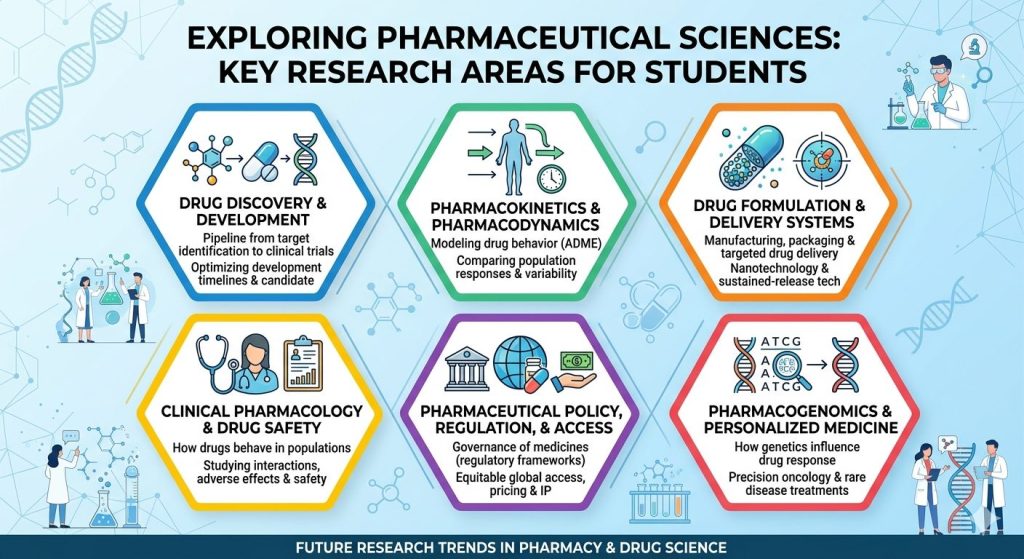
The pharmaceutical sciences cover a wide range of disciplines. Understanding the major subfields helps you identify where your topic might sit and how to position it academically.
Drug Discovery and Development
This area covers the entire pipeline from identifying biological targets to clinical testing. Research in this space often focuses on reducing development timelines, improving candidate selection, or understanding failure rates in clinical trials.
Pharmacokinetics and Pharmacodynamics
These twin disciplines examine how drugs move through the body and how they produce their effects. Dissertation topics here often involve modelling drug behaviour, comparing population responses, or exploring variability in drug metabolism.
Drug Formulation and Delivery Systems
This subfield focuses on how drugs are manufactured, packaged, and delivered to the target site. Research in drug formulation is highly applied and has strong industry relevance, particularly in areas such as nanoparticle delivery and sustained-release technology.
Clinical Pharmacology and Drug Safety
Research in this area examines how drugs behave in human populations, including adverse effects, drug interactions, and post-market surveillance. Drug safety studies often use large datasets and epidemiological methods.
Pharmaceutical Policy, Regulation, and Access
This area examines the governance of medicines, including regulatory frameworks, pricing policies, intellectual property rights, and equitable access to medicines globally.
Pharmacogenomics and Personalised Medicine
This growing field looks at how genetic variation influences individual responses to drugs. It connects molecular biology with clinical practice and is increasingly relevant to precision oncology and rare disease treatment.
Five Example Dissertation Topics with Aims and Objectives
Understanding how a strong topic is structured is just as important as identifying one. The five examples below demonstrate how a clear aim and focused objectives create a researchable and academically sound proposal.
Example 1
Topic: The effectiveness of lipid nanoparticle drug delivery systems in improving bioavailability for poorly soluble drugs.
Aim: To evaluate the role of lipid nanoparticle technology in enhancing the bioavailability of BCS Class II drugs.
Objectives:
- To review existing literature on lipid-based formulation strategies for oral drug delivery
- To compare bioavailability outcomes across different nanoparticle formulations in preclinical studies
- To identify barriers to clinical translation of lipid nanoparticle systems
Example 2
Topic: Pharmacokinetic variability in elderly patients receiving polypharmacy: a systematic review.
Aim: To examine how age-related physiological changes affect drug pharmacokinetics in older patients prescribed multiple medications.
Objectives:
- To identify studies reporting pharmacokinetic parameters in elderly populations
- To analyse how renal and hepatic function decline affects drug clearance in this cohort
- To recommend evidence-based monitoring protocols for clinical practice
Example 3
Topic: Regulatory challenges in the approval of biosimilar medicines in the United Kingdom post-Brexit.
Aim: To assess how the regulatory landscape for biosimilars in the UK has changed following Brexit and what this means for market access.
Objectives:
- To compare UK and EU regulatory pathways for biosimilar approval
- To evaluate the impact of regulatory divergence on the availability of biosimilars in the NHS
- To propose recommendations for streamlining UK biosimilar approval processes
Example 4
Topic: The role of pharmacogenomics in predicting adverse drug reactions in patients receiving antidepressant therapy.
Aim: To investigate the extent to which pharmacogenomic testing can reduce the incidence of adverse drug reactions in patients prescribed antidepressants.
Objectives:
- To review evidence on genetic polymorphisms affecting antidepressant metabolism
- To assess the clinical utility of pharmacogenomic testing in psychiatric settings
- To evaluate cost-effectiveness considerations for implementing routine pharmacogenomic screening
Example 5
Topic: Antimicrobial resistance in hospital-acquired infections: the role of pharmaceutical stewardship programmes.
Aim: To examine how structured antibiotic stewardship programmes reduce antimicrobial resistance rates in acute hospital settings.
Objectives:
- To identify key components of effective stewardship programmes in NHS trusts
- To analyse outcome data from hospitals that have implemented stewardship frameworks
- To assess barriers to pharmacist-led stewardship in resource-limited hospital environments
80 Pharmaceuticals Dissertation Topics for 2026
The topics below are grouped by subfield and suitable for undergraduate, master’s, and PhD research. Each topic is narrow, researchable, and aligned with current academic and industry priorities.
Drug Discovery and Development
- The impact of artificial intelligence on early-stage drug target identification in oncology research
- Failures in phase III clinical trials: a systematic analysis of drug attrition between 2015 and 2025
- The use of organ-on-a-chip technology in reducing animal testing during preclinical drug development
- Repurposing existing approved drugs for rare disease treatment: opportunities and limitations
- How open-source drug discovery platforms are reshaping pharmaceutical R&D collaboration
- The role of patient-derived organoids in personalising cancer drug development pipelines
- Evaluating the efficiency of fragment-based drug discovery in identifying novel kinase inhibitors
- The contribution of computational chemistry to shortening lead optimisation timelines
- Regulatory incentives for orphan drug development and their impact on rare disease research investment
- Assessing the reproducibility crisis in pharmaceutical preclinical research and its implications for drug approval
Clinical Trials and Drug Safety
- Ethical considerations in placebo-controlled clinical trials for serious and life-threatening conditions
- The use of adaptive trial designs in accelerating vaccine development: lessons from COVID-19
- Post-market surveillance systems and their effectiveness in detecting long-term drug safety signals
- Informed consent processes in clinical trials involving cognitively impaired participants
- Gender disparities in clinical trial recruitment and their impact on drug safety data
- The role of pharmacovigilance databases in detecting drug-drug interactions across large populations
- Adverse drug reaction reporting rates in the UK Yellow Card scheme: trends and gaps from 2018 to 2024
- How electronic health records are improving real-world drug safety monitoring
- Comparing the safety profiles of biological versus small-molecule drugs in autoimmune disease management
- The impact of trial design heterogeneity on meta-analytic reliability in pharmacological systematic reviews
Pharmacokinetics and Pharmacodynamics
- Population pharmacokinetic modelling in paediatric patients receiving chemotherapy agents
- How body composition affects drug distribution and dosing requirements in obese adult patients
- Renal function as a predictor of drug clearance variability in patients with chronic kidney disease
- The pharmacodynamic response to opioid analgesics and the influence of tolerance on dosing
- Comparing single-dose and multiple-dose pharmacokinetics of novel oral anticoagulants
- The effect of food on the oral bioavailability of targeted kinase inhibitors in cancer patients
- Drug protein binding variability and its clinical implications in critically ill patients
- Chronopharmacology and the role of circadian rhythms in optimising drug dosing schedules
- Modelling pharmacokinetic-pharmacodynamic relationships for antifungal agents in immunocompromised patients
- The relevance of first-pass metabolism in explaining inter-individual variability in statin efficacy
Drug Formulation and Delivery Systems
- Advances in mucoadhesive drug delivery for improving the absorption of oral peptide therapeutics
- The application of 3D printing in producing personalised tablet formulations for paediatric patients
- Liposomal encapsulation as a strategy for reducing systemic toxicity in cytotoxic drug delivery
- Transdermal drug delivery systems for hormone replacement therapy: efficacy and patient acceptability
- Hydrogel-based sustained-release formulations for wound-healing applications in diabetic patients
- The role of cyclodextrin complexation in improving the solubility of BCS Class II pharmaceuticals
- Nanostructured lipid carriers for the targeted delivery of antifungal drugs to pulmonary tissue
- Inhalation drug delivery systems for chronic obstructive pulmonary disease: device performance and patient compliance
- Solid dispersion technology as a formulation approach for poorly water-soluble antiviral drugs
- Mucus-penetrating nanoparticles for improved drug delivery in cystic fibrosis patients
Pharmacogenomics and Personalised Medicine
- CYP2D6 polymorphisms and their influence on tamoxifen efficacy in breast cancer patients
- Pharmacogenomic predictors of response to biological therapies in rheumatoid arthritis management
- The clinical utility of TPMT genotyping before initiating thiopurine therapy in inflammatory bowel disease
- Genetic variation in drug transporters and its effect on antiretroviral pharmacokinetics in HIV patients
- Whole genome sequencing as a tool for identifying pharmacogenomic markers in cancer precision medicine
- The integration of pharmacogenomics into primary care prescribing: barriers and enablers in the UK
- HLA typing and its role in preventing serious cutaneous adverse drug reactions to carbamazepine
- Pharmacogenomics of antipsychotic drug response: implications for personalising schizophrenia treatment
- The economic case for pre-emptive pharmacogenomic testing in NHS polypharmacy patients
- Evaluating the clinical readiness of pharmacogenomics-guided prescribing in cardiovascular medicine
Antimicrobial Resistance and Infectious Disease
- The effectiveness of bacteriophage therapy as an alternative to antibiotics in drug-resistant infections
- Antibiotic prescribing patterns in UK primary care and their relationship to resistance rates from 2019 to 2024
- The role of efflux pumps in mediating multi-drug resistance in gram-negative bacteria
- Biofilm formation as a mechanism of antibiotic resistance in device-related hospital infections
- Antifungal resistance in Candida auris: global spread and implications for hospital infection control
- The use of combination antibiotic therapy in treating carbapenem-resistant Enterobacteriaceae infections
- Stewardship programme outcomes in reducing unnecessary fluoroquinolone prescribing in secondary care
- Colistin resistance mechanisms in Acinetobacter baumannii and their clinical relevance
- The role of the gut microbiome in modulating susceptibility to Clostridioides difficile infection
- Access to novel antibiotics in low-income countries: regulatory and economic barriers to equitable distribution
Pharmaceutical Policy, Regulation, and Access
- The impact of the Medicines and Healthcare products Regulatory Agency’s post-Brexit framework on drug approval timelines
- Pharmaceutical pricing negotiations and access to oncology medicines within the NHS
- Generic drug substitution policies and their influence on patient adherence and clinical outcomes
- The role of health technology assessment in shaping pharmaceutical reimbursement decisions in the UK
- Parallel importing of medicines in Europe and its implications for drug quality and regulatory oversight
- Compulsory licensing as a tool for improving access to essential medicines in sub-Saharan Africa
- The regulation of over-the-counter reclassification of prescription medicines in the United Kingdom
- Patient advocacy groups and their influence on pharmaceutical policy-making in rare diseases
- The ethics of differential pricing strategies for patented medicines in high- and low-income countries
- Regulatory frameworks for combination drug products: challenges and inconsistencies across global markets
Biopharmaceuticals and Biotechnology
- The development of next-generation mRNA therapeutics beyond COVID-19 vaccine applications
- Challenges in manufacturing monoclonal antibodies at scale: a process analytical technology perspective
- The regulatory pathway for cell and gene therapy products in the United Kingdom
- Antibody-drug conjugates in cancer treatment: mechanisms of action and clinical trial outcomes
- Stability challenges in biopharmaceutical formulation and their impact on cold-chain distribution
- Biosimilar substitution in clinical practice: prescriber attitudes and patient safety considerations
- The role of glycosylation in determining the biological activity of therapeutic proteins
- Engineering adeno-associated viral vectors for improved gene delivery efficiency in rare genetic disorders
- Advances in RNA interference therapeutics for silencing disease-causing gene expression
- The ethical dimensions of CRISPR-based therapeutics in treating heritable genetic conditions
Conclusion: Choosing Your Pharmaceutical Dissertation Topic with Confidence
Selecting a dissertation topic is one of the most consequential academic decisions you will make. In pharmaceutical sciences, that decision determines the relevance of your research, the strength of your methodology, and the contribution you make to a field that directly affects human health.
The 80 pharmaceutical research topics in this post represent a wide range of subfields, academic levels, and methodological approaches. Whether you are drawn to laboratory-based drug formulation research or policy-focused regulatory analysis, there is a topic here that can support a rigorous and original dissertation.
The key is to start narrow. A focused, well-defined topic gives you a manageable scope, a clear research question, and a stronger argument for academic significance. Avoid broad topics that cannot be meaningfully addressed within the word count and time constraints of your degree.
Take time to read recent journal articles in your chosen subfield, discuss your shortlisted topics with your supervisor early, and use this post as a starting point for your own deeper exploration. If you need structured academic support, online dissertation help from experienced pharmaceutical specialists can help you move from a rough idea to a fully developed research proposal.
Your dissertation is an opportunity to contribute something original to one of the world’s most important scientific disciplines. Approach it with care, curiosity, and the confidence that comes from being well-prepared.
