


Business Information Technology Dissertation Topics for 2026

What Students Are Asking About Business IT Dissertations
These questions have been gathered from student forums, academic discussion boards, and university help communities. They reflect the real concerns students raise when trying to choose a dissertation topic in business information technology.
- What are the best business information technology dissertation topics for 2026?
- How do I choose a dissertation topic that is narrow enough for my level of study?
- Which areas of business IT are most relevant for research right now?
- Are there business IT dissertation topics on digital transformation I can use for a master’s?
- What is the difference between undergraduate and PhD-level business IT research topics?
- Can I find business information technology dissertation topics with examples and research objectives?
- Where do I start if I have no idea what topic to write about?
If you have asked any of these questions recently, you are not alone. Many students reach this stage of their academic journey feeling uncertain. This post is designed to guide you clearly from that point of confusion to a confident, well-informed topic choice.
Why Choosing the Right Business IT Dissertation Topic Matters
Choosing the right dissertation topic is one of the most important decisions you will make during your degree. In the field of business information technology, this decision carries particular weight. The field sits at the intersection of management, strategy, and technology, which means your topic must be precise enough to investigate properly but broad enough to draw on meaningful literature.
A poorly chosen topic can result in research that lacks direction, fails to meet academic standards, or struggles to find relevant sources. On the other hand, a well-selected topic gives your dissertation a clear purpose, aligns with existing scholarly conversations, and contributes something valuable to the field.
Business IT is one of the fastest-evolving disciplines in academic research. What was considered cutting-edge five years ago may now be considered standard practice. This makes it essential to ground your topic in current research conversations while still connecting it to a solid body of existing literature.
If you are feeling overwhelmed at this stage, consider seeking online dissertation help from a qualified academic professional who understands the specific demands of this field.
Download Business Information Technology Dissertation Topics PDF
Students who want a personalised list of curated dissertation topics can receive a downloadable PDF compiled by subject-area academic experts. This resource is designed to save you time during the topic selection process and ensure the topics you consider are academically suitable for your level of study. The PDF is made available after students complete a short request form, which helps the team tailor the topic list to your specific programme and research interests.
Key Research Areas in Business Information Technology
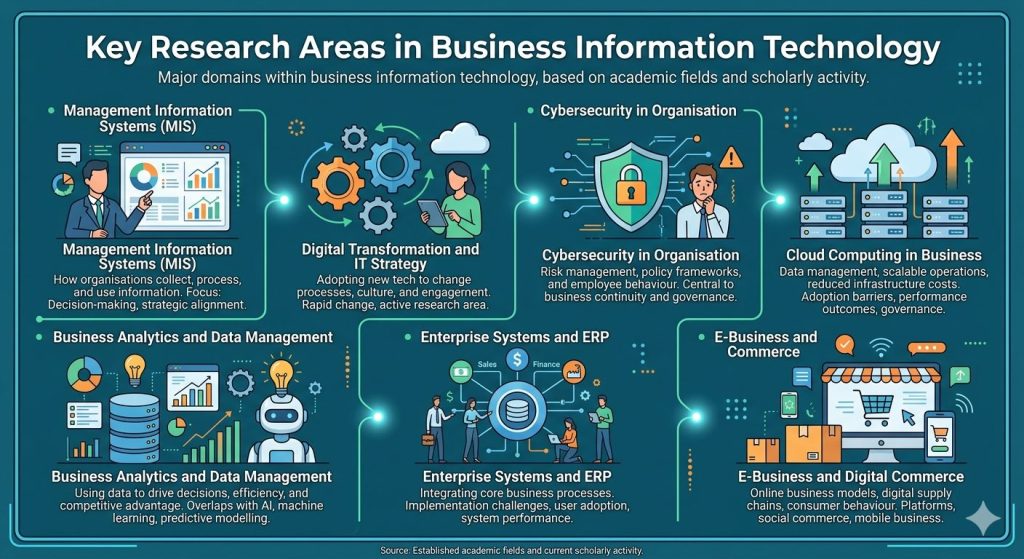
Before selecting a topic, it helps to understand the major research domains within business information technology. These areas are based on established academic fields and current scholarly activity.
Management Information Systems (MIS)
MIS focuses on how organisations collect, process, and use information to support decision-making. Research in this area often examines how information systems align with business strategy and organisational structure.
Digital Transformation and IT Strategy
This domain explores how organisations adopt new technologies to change their processes, culture, and customer engagement. It remains one of the most active areas in business IT research due to rapid technological change.
Cybersecurity in Organisation
As organisations depend more on digital infrastructure, cybersecurity has become central to business continuity and governance. Dissertation research in this area examines risk management, policy frameworks, and employee behaviour.
Cloud Computing in Business
The adoption of cloud services has transformed how businesses manage data, scale operations, and reduce infrastructure costs. Research topics here include adoption barriers, performance outcomes, and governance.
Business Analytics and Data Management
This area looks at how businesses use data to drive decisions, improve efficiency, and gain competitive advantage. It overlaps with artificial intelligence, machine learning, and predictive modelling.
Enterprise Systems and ERP
Enterprise resource planning systems integrate core business processes. Research in this area focuses on implementation challenges, user adoption, and system performance across different industries.
E-Business and Digital Commerce
This domain examines online business models, digital supply chains, and consumer behaviour in digital markets. It includes platforms, social commerce, and mobile business environments.
Five Example Dissertation Topics with Aims and Objectives
The following examples show how a well-structured business IT dissertation topic is constructed. Each includes a research aim and two to three objectives to guide your understanding.
Example 1: Digital Transformation in UK SMEs
Topic: Examining the barriers to digital transformation in small and medium-sized enterprises in the United Kingdom.
Research Aim: To investigate the key organisational and technological barriers that prevent SMEs from successfully implementing digital transformation strategies.
Research Objectives:
- To identify the main internal and external barriers SMEs face during digital transformation.
- To evaluate how leadership and organisational culture influence digital adoption in SMEs.
- To recommend practical strategies that support SMEs in overcoming transformation barriers.
Example 2: Cybersecurity Governance in Financial Institutions
Topic: Assessing the effectiveness of cybersecurity governance frameworks in UK retail banking.
Research Aim: To evaluate how cybersecurity governance frameworks are implemented and maintained in the UK retail banking sector.
Research Objectives:
- To examine the governance structures currently in place within major UK retail banks.
- To assess the alignment between regulatory requirements and internal cybersecurity policies.
- To identify gaps in current governance models and propose improvements.
Example 3: Cloud Computing Adoption in the NHS
Topic: Exploring the challenges of cloud computing adoption within the National Health Service.
Research Aim: To understand the technical, regulatory, and organisational challenges facing NHS organisations adopting cloud computing.
Research Objectives:
- To identify the primary challenges NHS organisations report during cloud migration.
- To evaluate how data protection regulations influence cloud adoption decisions.
- To assess the role of IT leadership in supporting cloud strategy within healthcare settings.
Example 4: AI-Driven Business Analytics
Topic: The impact of artificial intelligence on business analytics decision-making in retail organisations.
Research Aim: To explore how AI-powered analytics tools influence strategic decision-making in large retail organisations.
Research Objectives:
- To examine the types of AI analytics tools used by major UK retailers.
- To assess how these tools affect the accuracy and speed of business decisions.
- To identify the organisational factors that support or hinder AI analytics adoption.
Example 5: ERP Implementation in Manufacturing
Topic: Critical success factors for ERP system implementation in the UK manufacturing sector.
Research Aim: To identify and evaluate the factors that determine success or failure in ERP implementation within UK manufacturing firms.
Research Objectives:
- To review the academic and practitioner literature on ERP implementation success.
- To examine case studies of ERP rollouts within UK manufacturing companies.
- To develop a framework of critical success factors applicable to mid-sized manufacturers.
80 Business Information Technology Dissertation Topics for 2026
The following topics are organised under research subfields. Each topic is designed to be narrow, researchable, and aligned with current academic expectations for 2026. Students working on IT management dissertation research will find topics at undergraduate, master’s, and doctoral level throughout this list.
Digital Transformation and IT Strategy Topics
- How digital transformation strategies affect employee performance in UK retail organisations.
- The role of IT leadership in driving digital transformation success in public sector organisations.
- Barriers to digital transformation adoption in UK higher education institutions.
- Evaluating the strategic alignment between IT investment and business outcomes in FTSE 100 companies.
- How agile IT strategy supports business resilience during periods of economic uncertainty.
- The impact of digital maturity on organisational competitive advantage in the financial services sector.
- Exploring the relationship between digital transformation readiness and firm performance in SMEs.
- How organisations measure the return on investment of digital transformation initiatives.
- The role of change management in sustaining digital transformation outcomes in logistics firms.
- Digital strategy adoption in UK local government authorities: barriers and enablers.
Management Information Systems Topics
- The effectiveness of management information systems in supporting strategic decision-making in NHS Trusts.
- How MIS implementation affects operational efficiency in UK retail supply chains.
- User resistance to MIS adoption in non-profit organisations and its organisational consequences.
- Evaluating MIS data quality standards in multi-site healthcare organisations.
- The influence of organisational culture on MIS utilisation in financial services firms.
- How real-time MIS dashboards affect managerial decision-making in fast-moving consumer goods companies.
- Assessing MIS integration challenges following mergers and acquisitions in UK banking.
- The relationship between MIS maturity and business performance in UK logistics companies.
- How emerging AI capabilities are being embedded into traditional management information systems.
- The role of MIS governance in preventing data misuse in public sector organisations.
Cybersecurity in Organisations Topics
- Assessing the effectiveness of employee cybersecurity training programmes in UK universities.
- How insider threats affect cybersecurity risk management in financial institutions.
- The role of zero-trust security architecture in protecting enterprise data in cloud environments.
- Cybersecurity policy compliance among remote workers in UK technology firms.
- How board-level awareness of cybersecurity risk influences organisational security outcomes.
- The impact of phishing simulation programmes on employee security behaviour in insurance companies.
- Evaluating the business continuity implications of ransomware attacks on UK SMEs.
- The effectiveness of ISO 27001 certification in reducing cybersecurity incidents in manufacturing firms.
- How GDPR compliance requirements have reshaped cybersecurity investment in UK organisations.
- Assessing the cyber resilience strategies of UK critical infrastructure operators.
Cloud Computing in Business Topics
- Organisational barriers to cloud migration in UK public sector bodies.
- How hybrid cloud models affect IT governance in large retail organisations.
- The influence of data sovereignty concerns on cloud adoption decisions among UK financial firms.
- Cost-benefit analysis of cloud computing adoption in NHS foundation trusts.
- Evaluating vendor lock-in risks in multi-cloud strategies for UK enterprises.
- How cloud computing adoption affects the IT workforce structure in medium-sized businesses.
- The role of IT procurement policy in shaping cloud adoption strategies in UK universities.
- Cloud service reliability and its impact on business continuity in e-commerce organisations.
- How small businesses assess cloud security risks before migration in the professional services sector.
- The relationship between cloud maturity and supply chain efficiency in UK manufacturing firms.
Business Analytics and Data Management Topics
- The impact of predictive analytics on customer retention strategies in UK telecommunications.
- How data governance frameworks affect the quality of business analytics outputs in retail banking.
- Evaluating the adoption of real-time analytics in UK logistics and supply chain management.
- The role of data literacy in supporting analytics-driven decision-making in medium-sized firms.
- How AI-powered analytics tools affect the accuracy of demand forecasting in retail organisations.
- Assessing the challenges of big data integration in legacy IT environments within UK healthcare.
- The influence of data ethics policies on analytics strategy in UK financial institutions.
- How business intelligence adoption affects financial reporting accuracy in manufacturing firms.
- Evaluating the effectiveness of data visualisation tools in supporting executive decision-making.
- The relationship between data management maturity and business performance in UK professional services firms.
Enterprise Systems and ERP Topics
- Critical success factors in SAP ERP implementation for UK food and beverage manufacturers.
- How ERP system customisation affects long-term maintenance costs in medium-sized enterprises.
- User acceptance of ERP systems following post-merger system consolidation in UK retail.
- Evaluating the impact of ERP implementation on operational efficiency in public sector organisations.
- The role of project management methodology in ERP implementation success in UK logistics firms.
- How post-implementation support affects ERP adoption rates in UK SMEs.
- Assessing the alignment between ERP system capabilities and organisational process requirements in healthcare.
- The influence of cloud-based ERP on business scalability in high-growth UK technology companies.
- How ERP data quality issues affect financial reporting in UK construction firms.
- Evaluating the total cost of ownership of ERP systems in UK higher education institutions.
E-Business and Digital Commerce Topics
- How mobile commerce platforms affect purchasing behaviour among UK consumers aged 18 to 35.
- The impact of social commerce on brand loyalty in UK fashion retail.
- Evaluating the effectiveness of AI-powered product recommendation engines in e-commerce conversion rates.
- How digital payment systems influence consumer trust in UK online retail.
- The role of omnichannel integration in improving customer experience in UK grocery retail.
- Assessing the adoption of voice commerce technology among UK consumers.
- How subscription-based e-commerce models affect customer lifetime value in UK beauty retail.
- The impact of user-generated content on purchase decisions in UK online fashion platforms.
- Evaluating the regulatory challenges facing cross-border e-commerce firms operating from the UK post-Brexit.
- How chatbot technology affects customer service efficiency in UK online retail organisations.
Emerging Technologies and Innovation Topics
- The adoption of blockchain technology for supply chain transparency in UK pharmaceutical companies.
- How Internet of Things (IoT) integration affects operational efficiency in UK smart manufacturing firms.
- The business implications of quantum computing adoption for UK financial services organisations.
- Evaluating the organisational readiness for generative AI adoption in UK professional services firms.
- How augmented reality applications affect customer engagement in UK retail environments.
- The role of edge computing in supporting real-time decision-making in UK logistics operations.
- Assessing the business case for robotic process automation in UK insurance companies.
- How digital twin technology supports predictive maintenance in UK energy sector organisations.
- The impact of natural language processing tools on knowledge management in UK law firms.
- Evaluating the ethical implications of algorithmic decision-making in UK human resources management.
How to Choose the Right Topic for Your Level of Study
Not every topic in the list above will suit every student. The level of your programme matters. Undergraduate students typically need a topic that is focused, manageable in scope, and supported by accessible literature. Master’s students are expected to engage critically with existing theory and demonstrate original thinking. PhD candidates must contribute new knowledge to the field, which requires an even narrower and more rigorously justified topic.
If you are pursuing business IT dissertation topics for undergraduate study, look for topics where data collection is straightforward and the research question is clearly defined. Master’s students writing on information systems dissertation topics should aim to bridge theory and practice, ideally by connecting established frameworks to contemporary organisational challenges.
If you are still unsure which topic suits your level, seeking business IT dissertation help from an experienced academic professional can save you significant time and academic stress.
Aligning Your Topic with Current Research Trends
The best dissertation topics in 2026 reflect what is actually happening in organisations right now. Research into artificial intelligence, generative models, cybersecurity risks, and digital sustainability is growing rapidly. At the same time, foundational topics in information systems, ERP implementation, and IT governance remain highly relevant and well-supported by academic literature.
You do not need to choose the most fashionable topic. You need to choose a topic that you can research rigorously within your time and resource constraints. A focused study on a well-established area, conducted with strong methodology, will always outperform an ambitious study on a trendy topic that lacks depth.
Conclusion
Choosing a dissertation topic in business information technology is a significant academic decision, but it does not have to be an overwhelming one. This post has given you an overview of the key research areas within the field, five worked examples of how to structure a topic with aims and objectives, and 80 original, up-to-date dissertation topics across eight specialist subfields.
The most important principle to remember is that a good topic is specific, researchable, and grounded in current academic conversation. It does not have to be groundbreaking to be excellent. Clarity of purpose, rigour in methodology, and honesty in analysis are what make a dissertation truly strong.
Approach your topic selection with patience and intellectual curiosity. Use the examples and topic lists in this post as a starting point, not a final decision. Speak to your supervisor early, review recent journal articles in your chosen area, and make sure your topic genuinely interests you. Research is difficult when the subject does not engage you.
If you need further support at any stage of this process, whether that is refining your topic, structuring your proposal, or working through your research methodology, experienced academic support is available to help you move forward with confidence.
