


Blockchain Dissertation Topics for 2026

What Students Are Asking About Blockchain Dissertation Topics
The following questions have been gathered from student forums, Reddit threads, academic discussion groups, and university Q&A boards. They reflect what students genuinely struggle with when choosing a dissertation topic in blockchain and distributed ledger technology.
- What are the most relevant blockchain dissertation topics for 2026?
- How do I choose a blockchain research topic that is original and researchable?
- Are there easy blockchain dissertation topics with examples I can adapt?
- What blockchain research areas are suitable for a master’s or PhD level?
- How do I find innovative blockchain research topics for masters that have not been overdone?
- Can I base my dissertation on decentralised finance dissertation topics?
- Which blockchain topics are most likely to be approved by my supervisor?
- What makes a blockchain thesis topic academically strong in 2026?
If any of these sound familiar, this post will help you work through the confusion and find a direction that suits your level, your interests, and the expectations of your academic institution.
Why Choosing the Right Blockchain Dissertation Topic Matters
Blockchain technology has moved well beyond its early association with cryptocurrency. Today, it sits at the centre of research in finance, governance, healthcare, law, supply chain management, and cybersecurity. For students working at undergraduate, master’s, or doctoral level, selecting the right topic in this field is one of the most consequential decisions they will make during their academic journey.
A poorly chosen topic can lead to shallow research, limited academic sources, and difficulty completing the dissertation on time. A well-chosen topic, on the other hand, gives students a clear direction, a body of literature to engage with, and the ability to make a meaningful contribution to ongoing academic conversation.
Many students seek online dissertation help precisely because they feel overwhelmed by how broad and fast-moving this field is. Blockchain is not a single subject. It spans technical architecture, legal frameworks, economic theory, and organisational behaviour. Understanding how to narrow your focus appropriately is the first skill this post will help you develop.
Blockchain research in 2026 is shaped by real-world applications, regulatory changes, sustainability concerns, and the growing intersection of blockchain with artificial intelligence. This post helps you tap into those trends while staying grounded in academically sound research practice.
Download Blockchain Dissertation Topics PDF
Students who need a personalised starting point can receive a downloadable PDF containing a curated list of blockchain dissertation topics reviewed and organised by academic subject specialists. This resource is made available after completing a short form, allowing the team to tailor the topic list to your academic level, institution type, and research interests. No promotional commitment is required. The form is designed only to ensure the topics you receive are genuinely relevant to your programme and field of study.
Key Research Areas in Blockchain You Can Explore
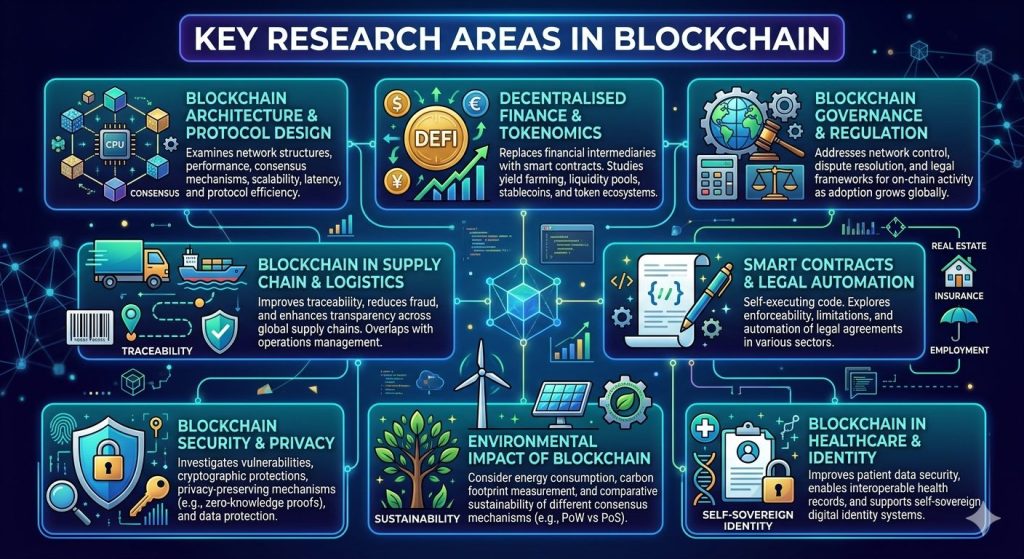
Before selecting a dissertation topic, it helps to understand the major research domains within blockchain studies. These are not invented categories. They reflect established academic fields that have generated peer-reviewed research, conference papers, and doctoral theses over the past decade.
Blockchain Architecture and Protocol Design
This area examines how blockchain networks are built, how consensus mechanisms function, and how different architectural choices affect performance and security. Researchers in this space often investigate scalability, latency, and protocol efficiency.
Decentralised Finance and Tokenomics
Decentralised finance, often referred to as DeFi, covers the replacement of traditional financial intermediaries with smart contracts and decentralised protocols. Research in this area spans yield farming, liquidity pools, stablecoin mechanics, and the economic behaviour of token ecosystems.
Blockchain Governance and Regulation
As blockchain adoption grows, questions of governance become critical. Who controls a network? How are disputes resolved? What legal frameworks apply to on-chain activity? This area is growing rapidly as regulators worldwide attempt to create workable frameworks for decentralised systems.
Blockchain in Supply Chain and Logistics
One of the most mature applied research areas, this field examines how distributed ledger technology can improve traceability, reduce fraud, and enhance transparency across global supply chains. It overlaps significantly with operations management and international trade law.
Smart Contracts and Legal Automation
Smart contracts are self-executing code stored on a blockchain. Research in this area explores their enforceability, their limitations, and their potential to automate legal agreements across sectors such as real estate, insurance, and employment.
Blockchain Security and Privacy
This technical domain investigates vulnerabilities in blockchain systems, cryptographic protections, privacy-preserving mechanisms like zero-knowledge proofs, and the challenges of combining transparency with data protection obligations.
Environmental Impact of Blockchain
The environmental impact of blockchain mining, particularly proof-of-work systems, has attracted significant regulatory and academic attention. Research here considers energy consumption, carbon footprint measurement, and the comparative sustainability of different consensus mechanisms.
Blockchain in Healthcare and Identity Management
This applied area investigates how blockchain can improve patient data security, enable interoperable health records, and support self-sovereign digital identity systems that return control of personal data to individuals.
Five Example Dissertation Topics with Research Aims and Objectives
The following examples show how a strong dissertation topic is structured. Each includes a research aim and two to three objectives to demonstrate the kind of focus and clarity supervisors expect.
Example 1
Topic: Evaluating the Scalability of Layer 2 Blockchain Solutions for High-Volume Financial Transactions
Research Aim: To assess whether Layer 2 scaling technologies can meet the throughput demands of mainstream financial payment networks without compromising decentralisation or security.
Objectives:
- To compare the transaction processing capacity of leading Layer 2 protocols against existing centralised payment infrastructure
- To evaluate the security trade-offs introduced by different Layer 2 approaches
- To assess the practical feasibility of Layer 2 adoption in regulated financial environments
Example 2
Topic: The Regulatory Landscape for Decentralised Finance in the European Union: Gaps, Risks, and Policy Recommendations
Research Aim: To examine how existing EU financial regulation applies to decentralised finance protocols and to identify areas where current frameworks are inadequate.
Objectives:
- To map existing EU regulatory instruments against the functional components of DeFi systems
- To identify regulatory gaps that create systemic risk for retail investors
- To propose evidence-based policy recommendations for a DeFi-specific regulatory framework
Example 3
Topic: Using Blockchain to Improve Pharmaceutical Supply Chain Transparency: A Case Study Approach
Research Aim: To investigate whether blockchain-based traceability systems can reduce counterfeit drug distribution in emerging markets.
Objectives:
- To review existing blockchain implementations in pharmaceutical logistics
- To identify barriers to adoption in low-income country contexts
- To assess the cost-benefit balance of blockchain traceability relative to existing verification systems
Example 4
Topic: Privacy Preservation in Public Blockchains: An Evaluation of Zero-Knowledge Proof Applications
Research Aim: To critically evaluate the effectiveness of zero-knowledge proof technologies in enabling private transactions on transparent public blockchains.
Objectives:
- To explain the technical mechanisms of leading zero-knowledge proof systems
- To assess their computational overhead and its implications for network performance
- To evaluate user adoption patterns and barriers in privacy-focused blockchain applications
Example 5
Topic: Carbon Footprint Accountability in Blockchain Networks: Towards a Standardised Measurement Framework
Research Aim: To develop a standardised framework for measuring and comparing the environmental impact of different blockchain networks.
Objectives:
- To review existing carbon accounting methodologies applied to blockchain energy consumption
- To identify inconsistencies in current reporting standards across major blockchain networks
- To propose a reproducible framework for environmental impact assessment in blockchain research
80 Blockchain Dissertation Topics for 2026
The following topics are organised by subfield. They are numbered in fixed ranges and are suitable for undergraduate, master’s, and PhD research proposals. All topics are original, narrow in focus, and aligned with current academic and industry priorities.
Blockchain Architecture and Scalability
- Comparing consensus mechanism efficiency across proof-of-work, proof-of-stake, and delegated proof-of-stake networks
- The role of sharding in addressing scalability challenges in blockchain: a technical evaluation
- Cross-chain interoperability protocols: a comparative analysis of bridge security and performance
- Evaluating the impact of block size increases on network decentralisation in Bitcoin forks
- Performance benchmarking of permissioned versus permissionless blockchains in enterprise environments
- How Layer 2 rollup technologies affect the decentralisation properties of Ethereum
- Modelling network congestion and fee volatility in high-demand blockchain environments
- Directed acyclic graph (DAG) architectures as alternatives to linear blockchain design: opportunities and constraints
- The trade-off between throughput and security in next-generation blockchain protocols
- Assessing the technical readiness of quantum-resistant cryptographic approaches for blockchain integration
Decentralised Finance Dissertation Topics
- Systemic risk in decentralised lending protocols: an analysis of cascading liquidation events
- The economic behaviour of automated market makers under conditions of extreme market volatility
- Stablecoin design mechanisms and their resilience to de-pegging events: a comparative study
- Governance token distribution and its effect on power concentration in DeFi protocols
- The role of oracles in DeFi: vulnerabilities, manipulation risks, and mitigation strategies
- Yield farming incentive structures and their long-term sustainability in decentralised finance ecosystems
- Institutional adoption of DeFi protocols: barriers, risks, and regulatory implications for UK-regulated firms
- Cross-border remittance via DeFi: cost savings, risks, and access challenges for unbanked populations
- The impact of Ethereum’s transition to proof-of-stake on DeFi transaction costs and accessibility
- Comparing centralised exchange vulnerabilities with decentralised exchange risks for retail investors
Smart Contracts and Legal Frameworks
- The enforceability of smart contracts under English contract law: a doctrinal analysis
- Smart contract auditing standards: a gap analysis of current industry practices and academic proposals
- Automated dispute resolution in blockchain-based commercial agreements: feasibility and limitations
- Smart contracts in real estate: reducing conveyancing fraud and delays in UK property transactions
- The liability of smart contract developers when code errors cause financial loss
- Insurance automation through parametric smart contracts: applications in agricultural risk management
- Self-executing employment contracts on blockchain: implications for worker rights and regulatory compliance
- Embedding anti-money laundering controls within smart contract logic: technical and legal challenges
- Smart contracts and intellectual property licensing: a framework for automated rights management
- Evaluating the use of smart contracts in public procurement to reduce corruption in developing economies
Blockchain Security and Privacy
- A systematic review of 51% attack vulnerabilities across proof-of-work blockchain networks
- Zero-knowledge proof applications in identity verification: balancing privacy and regulatory compliance
- Analysing reentrancy attack patterns in Solidity smart contracts and their prevention strategies
- The adequacy of GDPR data protection rights in the context of immutable blockchain ledgers
- Confidential transaction protocols and their effectiveness in preserving financial privacy on public blockchains
- Security risks introduced by cross-chain bridge protocols: an empirical analysis of bridge exploits
- Ransomware payment tracing through blockchain analytics: methods, limitations, and ethical concerns
- The effectiveness of formal verification methods in eliminating critical smart contract vulnerabilities
- Side-channel attacks on hardware wallets: a technical evaluation of current mitigation measures
- Decentralised identity systems and their resilience against Sybil attacks
Blockchain in Supply Chain Management
- Blockchain traceability in the cocoa supply chain: addressing child labour and sustainability certifications
- The adoption of distributed ledger technology in cold chain logistics for pharmaceutical products
- Evaluating blockchain-based provenance systems for luxury goods authentication in the fashion industry
- Barriers to blockchain adoption in small and medium enterprises within UK manufacturing supply chains
- Tokenisation of carbon credits on blockchain: improving transparency and reducing double-counting fraud
- Blockchain integration with Internet of Things devices for real-time supply chain monitoring
- The impact of distributed ledger technology on customs clearance efficiency in cross-border trade
- Comparing on-chain and off-chain data storage strategies for supply chain blockchain implementations
- Blockchain for food safety traceability: lessons from pilot programmes in the UK grocery sector
- Smart contracts in trade finance: reducing documentary fraud and processing delays in letters of credit
Tokenisation of Assets and Digital Finance
- The legal classification of tokenised real-world assets under UK financial services regulation
- Non-fungible tokens as a mechanism for fractional ownership of commercial real estate
- Central bank digital currency design: comparing retail CBDC models across G20 economies
- Tokenisation of government bonds: implications for sovereign debt market liquidity and transparency
- The role of asset tokenisation in improving access to private equity investment for retail investors
- Regulatory arbitrage risks arising from cross-border tokenised asset offerings
- NFT market dynamics and the determinants of price formation in digital art markets
- Programmable money and its implications for monetary policy transmission in digital currency systems
- Security token offerings compared with initial coin offerings: investor protection and market integrity
- Blockchain-based fractional ownership models for intellectual property: opportunities and legal barriers
Environmental Impact of Blockchain
- A comparative life-cycle assessment of energy consumption across major blockchain consensus mechanisms
- Quantifying the carbon intensity of Bitcoin mining in regions with different energy mixes
- The Ethereum Merge and its measured impact on network energy consumption: an empirical assessment
- Regulatory responses to blockchain energy consumption: a comparative analysis of EU and US approaches
- Green blockchain initiatives: evaluating the credibility of renewable energy claims by mining operators
- The role of proof-of-stake transition strategies in reducing blockchain’s contribution to global carbon emissions
- Electronic waste generated by proof-of-work mining hardware: an underexplored environmental cost
- Corporate sustainability reporting and blockchain energy disclosure: standards, gaps, and accountability
- Incentive structures for sustainable blockchain network participation: a behavioural economics perspective
- The feasibility of energy-efficient consensus alternatives for national digital currency infrastructure
Blockchain in Healthcare and Identity
- Patient-controlled health records using blockchain: implementation challenges in NHS digital infrastructure
- Blockchain-based vaccine supply chain tracking: lessons from COVID-19 rollout programmes
- Self-sovereign identity systems and their application in cross-border humanitarian aid delivery
- Interoperability barriers between blockchain health data platforms and existing hospital information systems
- Using distributed ledger technology to prevent prescription drug fraud in community pharmacy settings
- Blockchain for clinical trial data integrity: reducing selective reporting and outcome switching
- Digital identity on blockchain for stateless persons: legal recognition, technical feasibility, and ethics
- Genomic data sharing using blockchain: consent management, privacy, and commercialisation risks
- Blockchain in mental health record management: balancing transparency with patient confidentiality rights
- Decentralised credentialing systems for academic qualifications: combating degree fraud in international recruitment
Conclusion
Selecting a dissertation topic in blockchain technology is not about finding the most impressive-sounding title. It is about finding a question that is genuinely researchable, academically grounded, and aligned with your level of study. The 80 blockchain dissertation topics in this post cover the full breadth of the field, from technical architecture and blockchain security and privacy to governance, sustainability, and social applications.
Students who approach this process with curiosity and careful thought will find that blockchain offers exceptional opportunities for original, impactful research. Whether you are exploring decentralised finance dissertation topics for a master’s thesis, examining smart contracts for a law-focused dissertation, or investigating the environmental costs of proof-of-work mining for a PhD, there is genuine academic space for your contribution.
If you feel uncertain about your direction, remember that good topic selection often starts with a question you personally find compelling. From there, the academic framing follows. For students who need additional guidance on refining their chosen topic, blockchain research help is available through academic subject specialists who can help you develop a strong research proposal.
Approach your dissertation with intellectual honesty, a clear research focus, and confidence that the work you are about to undertake matters. The decisions you make at this stage will shape not only your grade but your understanding of one of the most consequential technologies of our time.
